
Gropuwy: br
News Update
Loading...
‏إظهار الرسائل ذات التسميات br. إظهار كافة الرسائل

الثلاثاء، 15 فبراير 2022

VR, AR, MR, XR: Which reality is the best?

VR, AR, MR, XR: Which reality is the best?

VR, AR, MR, XR: Which reality is the best?

When immersive experiences first became accessible to everyday consumers in the foreality, but some researchers are also studying removing stuff from reality. This could be used, for example, to focus on a particular subject in an environment while ignoring others. The term ‘mediated reality’ is sometimes used to describe both computer-generated interactions that add to our perception, as well as those that remove from it.


In general though, you’ll see MR and XR as the most common umbrella terms, as they most reflect the experiences consumers will buy into. Which one ends up being more popular remains to be seen. I’m a fan of mixed reality due to its history, but extended reality seems to be a little easier to explain since people don’t get hung up on the ‘mixed’ part.


In any case, I’d bet whatever Apple uses to describe its rumored headset will be the term that sticks around.


Examples of MR and XR: Microsoft HoloLens, pretty much all VR and AR headsets and experiences

Welcome to TNW Basics, a collection of tips, guides, and advice on how to easily get the most out of your gadgets, apps, and other stuff.


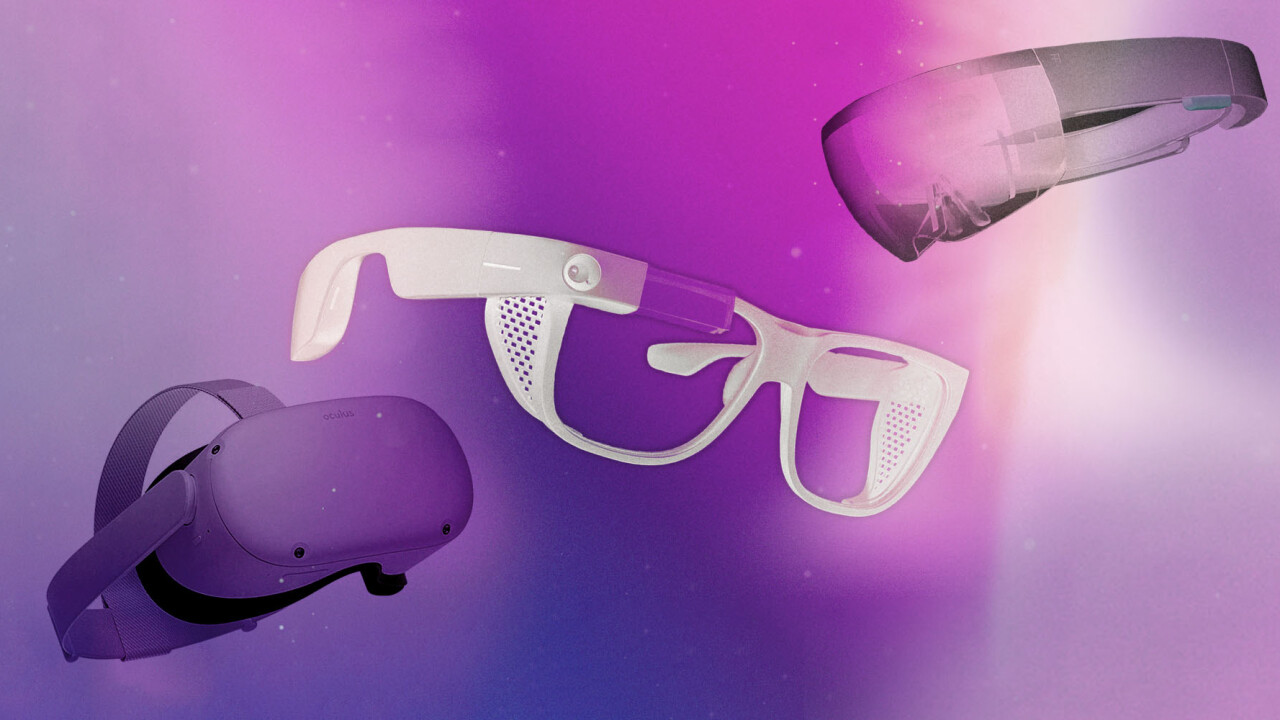
When immersive experiences first became accessible to everyday consumers in the form of headsets like the Oculus Rift and Google Glass, the industry appeared ripe for mainstream acceptance. A few years later, the hype around VR and AR has died down.


Then Facebook (the company) changed its name to Meta and signaled its investment in the metaverse. Suddenly everyone cared about VR and AR again.


Got plans next June?

Tickets to TNW 2022 are available now!


Yet I still find many people still aren’t quite clear on what all these terms mean. What’s the difference between augmented reality and virtual reality? What does ‘XR’ stand for, and what exactly is ‘mixed’ reality?


Fret no more friends, I’m here to help. I should note that some of these terms are constantly evolving and that sometimes academic/technical/corporate usage differs from colloquial usage (we’re primarily focused on the latter here), but this guide should help you make sense of our imminent immersive future.


Virtual Reality (VR)

Virtual reality is the OG. When people think of immersive computer-generated experiences beyond just gaming on a giant TV, VR is probably what comes to mind the most.


Credit: Oculus

Virtual reality generally refers to a fully immersive experience — replacing the real world with a fully computer-generated one. Typically, experiencing VR requires wearing an opaque headset that blocks your eyes from the real world. This generally counts even if the VR headset is creating a simulacrum of your surroundings. Some VR headsets, for instance, are able to project aspects of the real world into your field of view using headset-mounted cameras.


Basically, if you strap on something onto your face and can’t see out of it until you turn it on, that’s VR.


Examples: Oculus Rift/Go, HTC Vive, Google Cardboard, Nintendo Virtual Boy


Augmented Reality (AR)

Now things are getting a little muddier, but in general, AR is the counterpart to VR. While VR replaces the real world with computer-generated imagery, AR instead seeks to, erm, augment the real world with virtual experiences.


Therefore, when you’re experiencing AR, your perception is still guided by real-world objects and events.


Google Glass

Google Glass remains a classic example of AR

Unlike VR, AR doesn’t require you to be fully immersed in a headset — or use a headset at all, for that matter. If you’ve used a Snapchat filter, you’ve used a form of AR.


There are a number of apps now that allow you to superimpose 3D models onto an image of the real world — say, if you want to see how that armchair you’ve been eyeing will fit in your living room.


ARKit apple

Augmented reality doesn’t have to happen through a headset.

Augmented reality may not require sight either — some might consider location-based audio cues to be a form of augmented reality.


Examples: Pokemon GO, Google Glass, Magic Leap, Vuzix Blade


Mixed Reality (MR) and Extended Reality (XR)

I’m grouping these two together because depending on who you ask, these could be the same thing… or have more specific definitions. But in general, these are the two terms most often used as the over-arching terminology to encompass all computer-generated immersive experiences.


Microsoft, for example, is fond of the term mixed reality as a term for all digitally-enhanced events — both AR and VR. This implies that reality and virtuality exist on a spectrum — the aptly-named reality-virtuality continuum — and has its roots in academic research for decades. It was coined by researchers Paul Milgram and Fumio Kishino in a 1994 paper.


reality-virtuality continuum

On one end, you have the real world as the cave folk experienced it, free from any digital nonsense. On the other end, you have a completely virtual experience, where your senses are fully immersed in a virtual environment — this is closer to straight-up living in the Matrix.


Mixed reality is everything between these two extremes, so it generally works for both AR and VR. That includes devices that offer both technologies in one; you can imagine a headset that is transparent for augmented experiences, but can go opaque when the user wants to be fully immersed.


There are some even more complex and specific definitions for mixed reality, but the above should suffice for most of the time you encounter the term.


So what about extended reality (XR), then? Well… in most situations, it pretty much means the same thing.


That said, XR has gained some traction the last few years and is often defined more broadly; it’s also supposed to also cover all possible ‘R’s we haven’t even thought of yet. Mixed reality, while including AR and VR, tends to be a bit more associated with the former (perhaps due to Microsoft’s HoloLens).


Still, MR appears to be the more popular term overall:


It’s also worth noting that we’ve generally been talking about replacing or adding to reality, but some researchers are also studying removing stuff from reality. This could be used, for example, to focus on a particular subject in an environment while ignoring others. The term ‘mediated reality’ is sometimes used to describe both computer-generated interactions that add to our perception, as well as those that remove from it.


In general though, you’ll see MR and XR as the most common umbrella terms, as they most reflect the experiences consumers will buy into. Which one ends up being more popular remains to be seen. I’m a fan of mixed reality due to its history, but extended reality seems to be a little easier to explain since people don’t get hung up on the ‘mixed’ part.


In any case, I’d bet whatever Apple uses to describe its rumored headset will be the term that sticks around.


Examples of MR and XR: Microsoft HoloLens, pretty much all VR and AR headsets and experiences

Quantum computation is helping uncover materials that turn wasted heat into electricity

Quantum computation is helping uncover materials that turn wasted heat into electricity

 Quantum computation is helping uncover materials that turn wasted heat into electricity

The need to transition to clean energy is apparent, urgent and inescapable. We must limit Earth’s rising temperature to within 1.5 C to avoid the worst effects of climate change — an especially daunting challenge in the face of the steadily increasing global demand for energy.


Part of the answer is using energy more efficiently. More than 72 per cent of all energy produced worldwide is lost in the form of heat. For example, the engine in a car uses only about 30 per cent of the gasoline it burns to move the car. The remainder is dissipated as heat.


Recovering even a tiny fraction of that lost energy would have a tremendous impact on climate change. Thermoelectric materials, which convert wasted heat into useful electricity, can help.


Are we most creative when we're alone?

Here’s what the experts say


Until recently, the identification of these materials had been slow. My colleagues and I have used quantum computations — a computer-based modelling approach to predict materials’ properties — to speed up that process and identify more than 500 thermoelectric materials that could convert excess heat to electricity, and help improve energy efficiency.


Making great strides towards broad applications

The transformation of heat into electrical energy by thermoelectric materials is based on the “Seebeck effect.” In 1826, German physicist Thomas Johann Seebeck observed that exposing the ends of joined pieces of dissimilar metals to different temperatures generated a magnetic field, which was later recognized to be caused by an electric current.


Shortly after his discovery, metallic thermoelectric generators were fabricated to convert heat from gas burners into an electric current. But, as it turned out, metals exhibit only a low Seebeck effect — they are not very efficient at converting heat into electricity.


A black and white photo of a woman turning a dial on a large table top radio, with a lantern hanging above it.

The kerosene radio was designed for rural areas, and was powered by the kerosene lamp hanging above it. The flame created a temperature difference across metals to generate the electrical current. Image via ‘Popular Science’, Issue 6, 1956

In 1929, the Russian scientist Abraham Ioffe revolutionized the field of thermoelectricity. He observed that semiconductors — materials whose ability to conduct electricity falls between that of metals (like copper) and insulators (like glass) — exhibit a significantly higher Seebeck effect than metals, boosting thermoelectric efficiency 40-fold, from 0.1 per cent to four per cent.


This discovery led to the development of the first widely used thermoelectric generator, the Russian lamp — a kerosene lamp that heated a thermoelectric material to power a radio.


Are we there yet?

Today, thermoelectric applications range from energy generation in space probes to cooling devices in portable refrigerators. For example, space explorations are powered by radioisotope thermoelectric generators, converting the heat from naturally decaying plutonium into electricity. In the movie The Martian, for example, a box of plutonium saved the life of the character played by Matt Damon, by keeping him warm on Mars.


In the 2015 film, The Martian, astronaut Mark Watney (Matt Damon) digs up a buried thermoelectric generator to use the power source as a heater.

Despite this vast diversity of applications, wide-scale commercialization of thermoelectric materials is still limited by their low efficiency.


What’s holding them back? Two key factors must be considered: the conductive properties of the materials, and their ability to maintain a temperature difference, which makes it possible to generate electricity.


The best thermoelectric material would have the electronic properties of semiconductors and the poor heat conduction of glass. But this unique combination of properties is not found in naturally occurring materials. We have to engineer them.


Searching for a needle in a haystack

In the past decade, new strategies to engineer thermoelectric materials have emerged due to an enhanced understanding of their underlying physics. In a recent study in Nature Materials, researchers from Seoul National University, Aachen University and Northwestern University reported they had engineered a material called tin selenide with the highest thermoelectric performance to date, nearly twice that of 20 years ago. But it took them nearly a decade to optimize it.


To speed up the discovery process, my colleagues and I have used quantum calculations to search for new thermoelectric candidates with high efficiencies. We searched a database containing thousands of materials to look for those that would have high electronic qualities and low levels of heat conduction, based on their chemical and physical properties. These insights helped us find the best materials to synthesize and test, and calculate their thermoelectric efficiency.


We are almost at the point where thermoelectric materials can be widely applied, but first we need to develop much more efficient materials. With so many possibilities and variables, finding the way forward is like searching for a tiny needle in an enormous haystack.


Just as a metal detector can zero in on a needle in a haystack, quantum computations can accelerate the discovery of efficient thermoelectric materials. Such calculations can accurately predict electron and heat conduction (including the Seebeck effect) for thousands of materials and unveil the previously hidden and highly complex interactions between those properties, which can influence a material’s efficiency.


Large-scale applications will require themoelectric materials that are inexpensive, non-toxic and abundant. Lead and tellurium are found in today’s thermoelectric materials, but their cost and negative environmental impact make them good targets for replacement.


Quantum calculations can be applied in a way to search for specific sets of materials using parameters such as scarcity, cost and efficiency. Although those calculations can reveal optimum thermoelectric materials, synthesizing the materials with the desired properties remains a challenge.


A multi-institutional effort involving government-run laboratories and universities in the United States, Canada and Europe has revealed more than 500 previously unexplored materials with high predicted thermoelectric efficiency. My colleagues and I are currently investigating the thermoelectric performance of those materials in experiments, and have already discovered new sources of high thermoelectric efficiency.


Those initial results strongly suggest that further quantum computations can pinpoint the most efficient combinations of materials to make clean energy from wasted heat and the avert the catastrophe that looms over our planet.The Conversation

This article by Jan-Hendrik Pöhls, McCall MacBain Postdoctoral Fellow, Department of Chemistry and Chemical Biology, McMaster University, is republished from The Conversation under a Creative Commons license. Read the original article.

الجمعة، 11 فبراير 2022

Metaverse Dubai creates virtual replicas of city’s iconic areas using real-world maps

Metaverse Dubai creates virtual replicas of city’s iconic areas using real-world maps


Online services around us have transformed human interaction in professional as well as personal realms with social media taking over communication, e-commerce doubling up as a way to secure essentials, and fintech offering a medium for everything from banking to investments. As digital platforms surround us in real life, the pandemic has opened doors to a separate online realm where video conferencing and data sharing tools have replaced in person meetings so that people could attend seminars, virtual events and communicate with coworkers.

At the same time virtual reality has transformed entertainment by creating a separate ecosystem for gaming, which is now being used to create immersive worlds that people could enter by wearing headsets, and by creating digital avatars of themselves to meet others in the online sphere. Following the launch of a virtual reality gaming experience at a mall in Dubai last year, the city has now been replicated to create a virtual world using real world maps to bring iconic locations to life and set the stage for diverse tasks.

Once users enter the digital twin of the Middle Easter megacity, they can trade crypto tokens or even deal in digital real estate by taking a closer look at properties in Dubai,thanks to high quality visuals which capture the aesthetics and geometry of each location with precision. People can enter the metaverse in two different sessions and collect 1000 hexes at a time, with each of them costing 3000 MVP coins in the virtual realm.

The introduction of this online world follows the launch of virtual art galleries where people could check out digital artworks and attend concerts remotely as part of the new normal. Over the past few months, medtech has also enabled surgeons to collaborate on procedures from different parts of the world using virtual reality to share their knowhow in real-time.

Featured

[Featured][recentbylabel]

Featured

[Featured][recentbylabel]
Notification
This is just an example, you can fill it later with your own note.
Done